Why Your Small Business Needs a Website in 2026 (Even If You Have Instagram and a Google Profile)
By Digital Hivez · · 7 min read
You post on Instagram. Your Google Business Profile shows up on Maps. The phone rings now and then. So why pay for a website?
Because your customers go looking for one. In BrightLocal's 2026 Local Consumer Review Survey of 1,002 U.S. adults, 54% said they visit a business's website after reading positive reviews, up from 32% when BrightLocal last asked in 2019. No site means many of those buyers stop right there. This guide explains why your small business needs a website, what social pages and Google listings can't do, and the short list every small business site needs.
Why does a small business need a website?
A website is the one place online you own. It answers buying questions, proves you're a real business, and gives Google and AI tools something solid to read when they recommend local companies. Your social pages and listings help people find you. Your website helps them choose you.
Three things make it hard to skip in 2026:
- Customers research before they buy. The same BrightLocal survey found 66% of consumers keep researching after reading a good review, while 34% are ready to buy or book right away. Your website is where that research lands.
- Search still sends serious leads. In a 2025 Clutch survey of 406 U.S. small business owners, 40% of those with a website named search engine optimization (SEO) as their top lead source. Among owners without a site, 40% rely mainly on referrals.
- AI tools now shape who gets recommended. More on that below, because it's the biggest change since most owners last thought about their website.
Is a Google Business Profile enough?
No. Your Google Business Profile is a listing. It's excellent for Maps, reviews, and calls, but it can't hold a full page for each service, and Google controls it, not you.
- A real website is the safest link to give Google. Google's guidelines for Business Profiles warn against links that send people to pages other than the business's own, and they mention social media pages in that warning. Your own website is the clearest way to meet that rule.
- Free, borrowed space can disappear. Google once built simple free websites from Business Profiles on business.site addresses. As Search Engine Land reported, Google switched them off in March 2024, redirected visitors to the profile until June 10, 2024, and then the old addresses stopped working. Owners who relied on them had to start over.
Keep your profile, just don't make it your only home online. Only 35% of small and midsize businesses in BrightLocal's 2025 SMB Marketing report said they have a Google Business Profile at all, so running both well is still uncommon.
Facebook page vs. website: which does your business need?
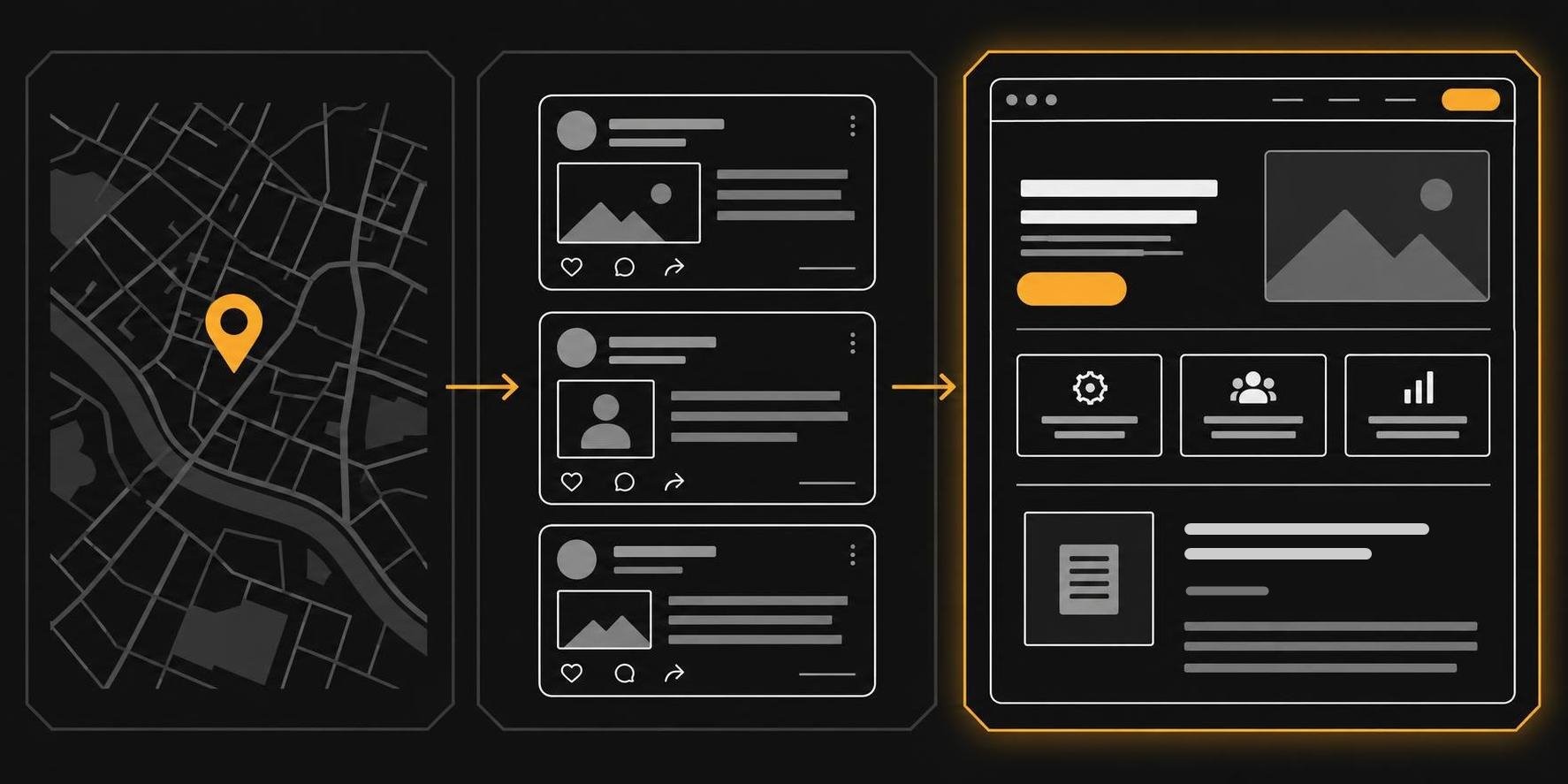
Both, because they do different jobs.
| Google Business Profile | Social media (Facebook, Instagram) | Your website | |
|---|---|---|---|
| Main job | Get found on Maps and local search | Stay in touch with people who know you | Turn interest into calls, bookings, and sales |
| Who controls it | Meta | You | |
| A page for every service | No | No | Yes |
| Built to rank for service searches | Map results only | Not designed for it | Yes, with solid SEO |
Social media is worth doing, but it rarely carries lead generation alone. In Clutch's 2025 survey, just 10% of small businesses called social media their top lead source, whether or not they had a website. Separately, BrightLocal's 2025 report found more small businesses market on Facebook (50%) and Instagram (44%) than say they have a dedicated website (40%). Social keeps you visible. Your website is where a stranger decides to call.
My business runs on word of mouth. Do I still need a website?
Yes, because referred customers look you up before they reach out. BrightLocal's 2026 survey found 97% of consumers read reviews for local businesses, and checking the website is the most common next step after a good review.
Clutch found that among small businesses without a website, the top reason was a belief that a site doesn't fit their industry (34%). Only 16% pointed to cost. Word of mouth makes someone curious. A website gives them the confidence to pick up the phone.
How AI search is changing the case for a website
People now ask AI tools which local business to use, and those tools read business websites. BrightLocal's 2026 survey found the share of consumers using ChatGPT and similar AI tools for local recommendations jumped from 6% to 45% in a year, making AI the third most popular source of business recommendations.
In a small 2025 BrightLocal test of 20 local searches across Google AI Mode, Gemini, Perplexity, and ChatGPT, businesses' own websites made up the large majority of sources the tools used, in every industry tested. Without a website, an AI tool has less to go on and must rely on whatever other sources it finds.
What a small business website needs: a simple checklist
You don't need a huge site. You need a clear one. Use this list to check what you have, or to brief whoever builds yours:
- The first line says what you do and where you do it
- One page for each main service, written the way customers describe their problem
- Your service area named in plain words
- A tap-to-call button and a short contact form near the top on phones
- The same business name, address, and phone number as your Google Business Profile
- Real photos and real customer reviews
- Fast loading on a phone, with text search engines can read easily
- One clear next step on every page: call, book, or request a quote
If you can't tick most of these boxes, that's the place to start.
Small business websites in New Jersey: why it matters here
New Jersey is home to 1.1 million small businesses, or 99.7% of all businesses in the state, according to the SBA Office of Advocacy's 2025 New Jersey profile, based on 2022 Census data. That's a lot of companies competing for the same local searches. Whether you run a restaurant, a service company, or a shop anywhere in New Jersey, a clear website that names your town and service area helps Google, and customers, connect you with nearby people who are ready to buy.
Frequently Asked Questions
Get a free Website + Google Business Profile audit
Not sure where your business stands? Digital Hivez offers small businesses a free audit of their website and Google Business Profile. We'll show you the biggest gaps and the quick wins worth fixing first, in plain language with no tech talk. Request yours through our contact page, send us a DM on Instagram at @digitalhivezai, or email contact@digitalhivez.com. Ready for a new site? See our website design and development service.
Sources
- BrightLocal — Local Consumer Review Survey 2026 (2026)
- BrightLocal — SMB Marketing Report 2025 (2025)
- BrightLocal — AI Search Makes Local Listings More Important Than Ever (2025)
- Clutch — Small Business Websites in 2025 (2025)
- NFIB — Small Business and Technology Survey (2025)
- Google — Guidelines for representing your business on Google (current)
- Search Engine Land — Google is shutting down websites made with Business Profiles (2024)
- SBA Office of Advocacy — 2025 Small Business Profile: New Jersey (2025)